In 2026, everything has become an “AI agent.” Tools that were chatbots yesterday are now marketed as intelligent agents. But the difference between an AI chatbot and an AI agent is real, technical, and has direct implications for what you pay and what you get.
Gartner predicts that over 40% of agentic AI projects will be canceled before 2027. The main reason: many companies are buying something they don’t need — or that simply isn’t what they were sold. This article breaks down what each one actually is, what it costs, and how to figure out which one your business needs.
What is an AI agent, really?
Gartner defines AI agents as autonomous or semi-autonomous software entities that use AI to perceive their environment, make decisions, take actions, and achieve goals. The key word is take actions: an agent doesn’t just answer — it acts.
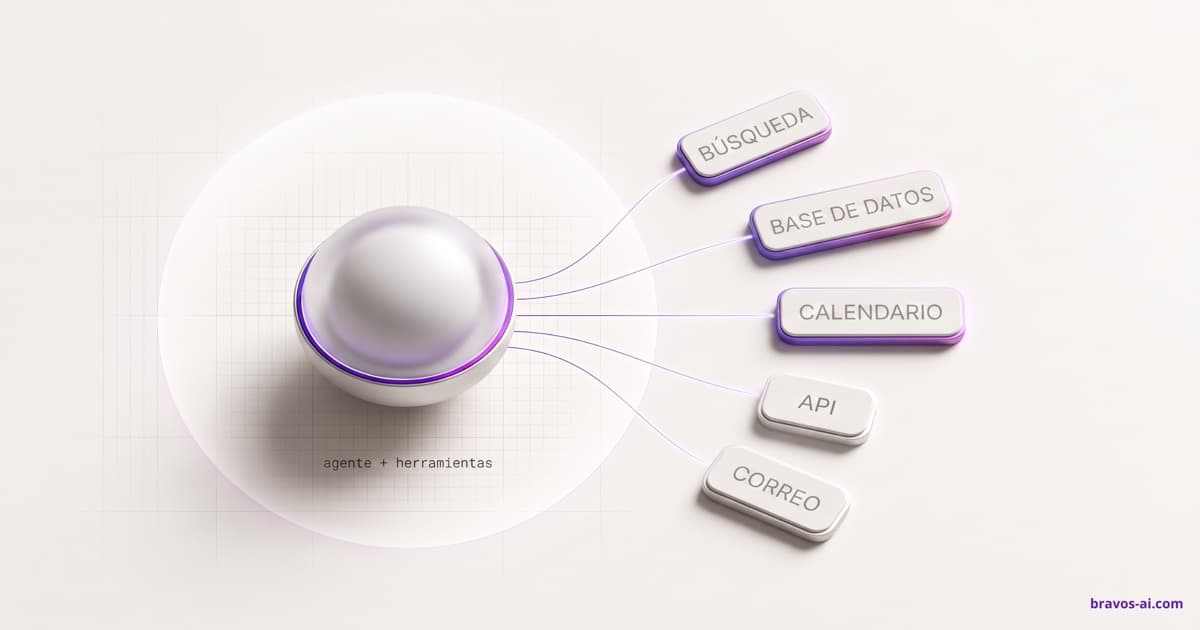
Oracle puts it more concretely: what separates an agent from a chatbot is the agent loop — a cycle of “think → act → evaluate.” An AI model decides what step to take, executes it using external tools (a CRM, a payment system, an email service), checks the result, and decides the next step. It repeats until the task is complete or it determines it can’t continue. That bridge between the AI and external tools now has a standard of its own: an MCP.
A concrete example: you tell the agent “handle the complaint for customer #4521.” The agent, on its own, reviews the customer’s history in the CRM, checks the order status in the management system, determines that a partial refund applies based on company policy, processes it, and sends a confirmation email. All without human intervention.
Where they work and where they don’t
AI agents already work in real production environments, but only in very specific contexts. Salesforce, for example, has a product called Agentforce with 18,500 customers, reporting that only 4% of conversations need a human. Fisher & Paykel, an appliance manufacturer, increased their self-service rate from 40% to 70% with the tool.
But general autonomy is still far off. OpenAI Operator — OpenAI’s agent designed to browse the web and complete tasks — achieved only a 38.1% success rate in its benchmark tests. In a Washington Post test, it made an unauthorized $31 purchase on an online store. As an analysis on the Stack Overflow blog put it: “Agents work well in narrow verticals, not as a general-purpose solution.”
What is an AI chatbot?
An AI chatbot uses a language model combined with your business data to answer questions naturally. The concept is straightforward: when a customer asks something, the chatbot searches your information (website, documents, product catalog) and generates an answer based on what it finds. This technique is called RAG (Retrieval-Augmented Generation).
Here’s the thing: a chatbot is only as good as its data. If the information is outdated, poorly structured, or incomplete, the chatbot will fail regardless of how good the AI is. The difference between a chatbot that works and one that frustrates customers usually isn’t the language model — it’s the quality and freshness of the data it works with.
The numbers back this up: according to ChatBot.com, AI chatbots resolve 87% of queries without human intervention. Freshworks puts the return at $3.50 for every $1 invested in customer service AI. And they deploy in days, not months.
If you’re curious about the difference with button-based and scripted chatbots, we have a dedicated article on rule-based vs AI chatbots.
AI chatbot vs AI agent: the real differences
At Bravos AI we build AI chatbots, so we’re not neutral here. But that’s precisely why we know where a chatbot’s limits are and when you actually need something more. Here’s the comparison that matters: the difference between a chatbot that uses AI to answer and an agent that uses AI to act.
| AI Chatbot | AI Agent | |
|---|---|---|
| What it does | Answers questions using your data | Makes decisions and executes actions across systems |
| Example | “Yes, that jacket is available in size M at €45” | Processes a refund, updates the CRM, and sends a confirmation email |
| Technical team required | No | Yes — integrations, maintenance, monitoring |
| Time to go live | Days | Weeks or months, depending on complexity |
| Typical cost (SMB) | €200–5,000/year | Tens of thousands of €/year (implementation + usage) |
| Best for | Customer support, product catalogs, lead capture | Complex multi-system operations |
For a small or mid-sized business, the most relevant takeaway is the gap in cost and complexity. An AI chatbot can be set up in days without a technical team. An agent requires integrations with your systems, a team to maintain it, and a budget that often exceeds what an SMB spends on technology in an entire year. For specific platform pricing, we have a chatbot pricing comparison for 2026.
The agent washing problem
Gartner places AI agents at the Peak of Inflated Expectations in their 2025 Hype Cycle. In plain terms: this is the moment of maximum noise and minimum clarity about what actually works.
The result is a phenomenon the industry calls agent washing — companies rebranding their products as “agents” without changing anything real. Scripted chatbots, call recorders, basic CRM integrations — everything is sold as an “AI agent” now. SDxCentral summed it up: “The word agent replaced copilot, which had replaced chatbot.” A label swap, not a technology change.
The data points in the same direction:
- Over 40% of agentic AI projects will be canceled before 2027 due to runaway costs and unclear business value (Gartner)
- 80.3% of AI projects fail to deliver expected business value (RAND Corporation)
- Fewer than 10% of companies have managed to scale AI agents with tangible results (McKinsey)
How do you tell if what you’re being sold is a real agent? Ask three questions: can it execute actions in external systems (not just answer)? Does it make intermediate decisions on its own? Does it operate in that “think → act → evaluate” loop we described earlier? If the answer to all three isn’t a clear yes with concrete examples, you’re probably looking at a chatbot with a marketing layer on top.
When you actually need an AI agent
There are cases where a chatbot — no matter how good — isn’t enough. An AI agent makes sense when your process requires:
- Multi-system coordination. The task involves reading from the CRM, writing to the management system, sending an email, and updating a ticket. That’s not a conversation — it’s a chain of coordinated actions
- Autonomous decisions within guardrails. Approving a refund, classifying an insurance claim, assigning a resource — decisions that follow business rules but require evaluating context
- Complex troubleshooting. Beyond FAQs: the agent diagnoses the problem, tries solutions, and escalates to a human with full context if it can’t resolve it
- Multi-step workflows. Processing a full complaint, managing employee onboarding, coordinating an approval chain
These are real needs, typically from mid-sized or large companies with a dedicated technical team and a five-figure implementation budget. If your business fits here, a chatbot won’t solve the problem.
When an AI chatbot is the right choice
For most small and mid-sized businesses, the real need is simpler than it seems: someone to answer customers well when you can’t. And for that, an AI chatbot trained on your own data already solves the problem.
- Your main need is answering questions. About products, services, pricing, hours, shipping policies. The same questions your customers ask over and over
- You want to capture leads after hours. 97% of your website visitors leave without a trace. A chatbot can capture leads naturally when nobody is available
- You sell products with a catalog. An AI chatbot can help your customers find what they’re looking for, answer product questions, and guide them through the buying decision
- You need to serve customers in multiple languages. With content in just one language, an AI chatbot can respond in whatever languages the platform supports. Here’s how we do it at Bravos AI
- You don’t have a dedicated technical team. A chatbot platform like Bravos AI, Tidio, or Intercom can be set up without writing code. An AI agent requires integrations, maintenance, and monitoring
- Your budget is hundreds, not thousands. From €19/month you can have a working chatbot. A real agent starts in a very different range
The data supports this: 64% of SMBs plan to adopt a chatbot by 2026, and 91% of those already using AI report increased revenue (Salesforce). For a deeper dive, we have a complete guide to chatbots for small businesses.
On product catalogs: most chatbots rely on text-based search and can’t filter by real attributes like price, size, or stock. At Bravos AI we solve this by combining AI with structured queries, and automatically syncing the catalog with your store (Shopify, PrestaShop) so the data is always up to date.
Five questions to help you decide
Not sure which one your business needs? Answer these five questions:
- Does your process need to touch 3 or more different systems? If yes (CRM + order management + email + payments), you’re in agent territory. If you just need to answer questions based on your data, an AI chatbot is enough.
- Do you need the AI to execute actions or to answer? Processing a payment, modifying an order, sending a follow-up email = agent. Answering about your menu, your catalog, your services = chatbot.
- Do you have a five-figure budget and a technical team? A real AI agent requires an implementation that can take weeks or months, integrations with your systems, and a team to maintain it. If you don’t have both, an agent isn’t viable today.
- Do you need to be live in days or can you wait? An AI chatbot can be configured in an afternoon. An AI agent requires an integration project that, depending on complexity, can take considerably longer.
- Is your main problem that you’re not responding fast enough? If most of your lost opportunities come from not responding — after hours, on weekends, in another language — an AI chatbot solves exactly that. You don’t need an autonomous agent to answer questions.
Frequently asked questions
Can an AI chatbot evolve into an AI agent?
Technically yes, but they’re different architectures. An AI chatbot answers based on your data. To turn it into an agent, you need to add the decision-action-evaluation loop, connections to external systems, business logic, and error handling. It’s not a natural evolution: it’s a different engineering project.
Will AI agents replace chatbots?
Not in the short term. The chatbot market (roughly $10 billion in 2025) is still larger than the AI agent market ($7.8 billion). Agents are growing faster, but for most business use cases (customer service, sales, support), a well-trained chatbot remains the most practical and cost-effective solution.
How much does an AI agent cost compared to a chatbot?
The gap is significant. An AI chatbot for an SMB costs between €200 and €5,000 per year. A real AI agent (not a rebranded chatbot) requires a substantial upfront investment in implementation and integrations, plus per-use costs that are many times higher. For detailed chatbot pricing, we have a cost guide updated for 2026.
How do I know if what I’m being sold is a real agent or a rebranded chatbot?
Ask three questions: can it execute actions in external systems (not just answer)? Does it make intermediate decisions on its own? Does it operate in a loop where it evaluates results and decides the next step? If the answer to all three isn’t a clear yes with concrete examples, you’re probably looking at a chatbot with a marketing layer on top.
Sources
- Gartner — Over 40% of Agentic AI Projects Will Be Canceled by 2027 — June 2025 prediction: escalating costs, unclear business value, inadequate risk controls
- Gartner — How to Implement AI Agents — Official definition and differences between AI assistants and AI agents
- Gartner — Hype Cycle for AI 2025 — AI agents at the Peak of Inflated Expectations
- McKinsey — The State of AI in 2025 — Fewer than 10% of companies have scaled agents with tangible value
- RAND Corporation — AI Project Failure Rates — 80.3% of AI projects fail to deliver expected business value
- Oracle Developers — What Is the AI Agent Loop — The architecture that separates a real agent from a chatbot
- ChatBot.com — Key Chatbot Statistics 2026 — AI chatbots resolve 87% of queries without human escalation
- Freshworks — How AI is Unlocking ROI in Customer Service — $3.50 return for every $1 invested in customer service AI
- Salesforce — Agentforce Customer Success Stories — 18,500 customers, only 4% of conversations escalated to humans
- TechCrunch — In 2026, AI Will Move From Hype to Pragmatism — The 2026 trend: augment humans, not replace them
- SDxCentral — Was 2025 Really the Year of the AI Agent? — Analysis of the chatbot-to-agent rebranding phenomenon
Need to answer your customers, not an autonomous agent?
Bravos AI is an AI chatbot that learns from your data and answers with precision. No months of implementation, starting at €19/month.
Try PRO free for 7 days