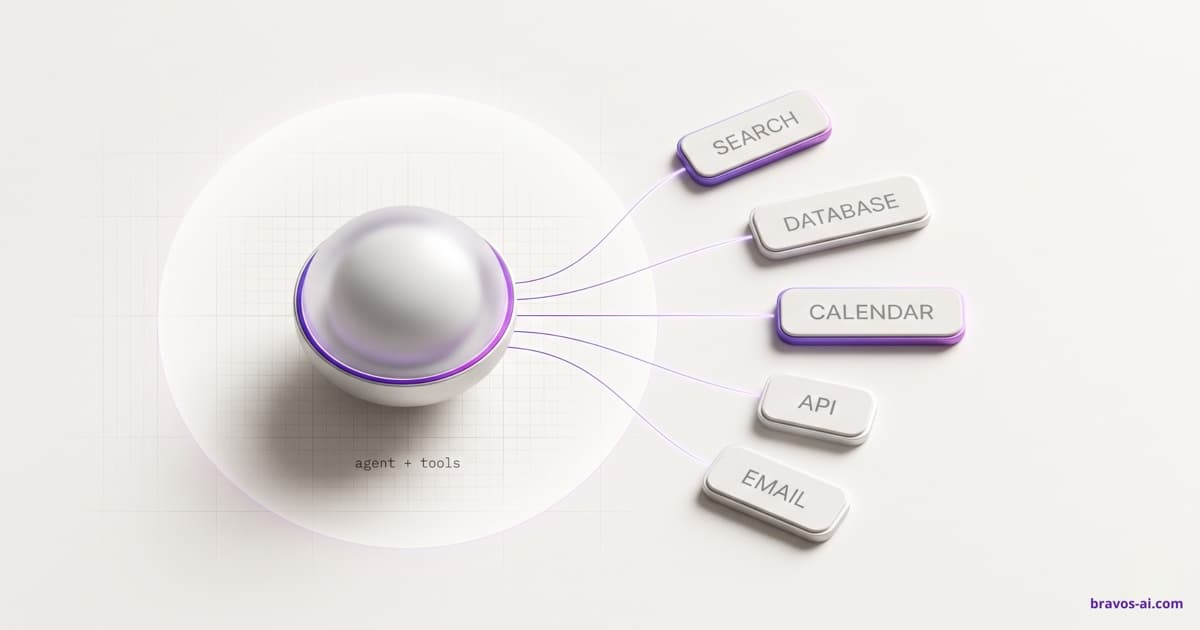
An AI agent is an artificial intelligence system that pursues a goal on its own: it decides what steps to take, uses tools (searches the web, calls other apps, taps into your systems), checks the result and tries again, with little human input. The difference from a chatbot is simple: a chatbot replies; an agent acts.
“AI agent” is the most-repeated term of 2026, and there’s so much noise around it that it’s hard to tell what one actually is and whether it’s useful for your business. The pages that rank at the top of Google are either technical encyclopedias written for developers, or brochures selling hype. This guide is the opposite: what an AI agent really is in plain English, how it works, what companies actually use them for, the part almost nobody mentions (why so many projects fail), and how to decide whether you need an agent, an assistant, or simply a good chatbot. With real sources, not headlines.
What an AI agent is
An AI agent is a program that uses a language model (the engine behind ChatGPT, Claude or Gemini) to achieve a goal, not just to answer a message. You give it an objective —“book me a flight”, “put together this month’s sales report”, “resolve this support ticket”— and the agent breaks that goal into steps, decides which tools it needs, uses them, looks at what came back and corrects course until it’s done.
The most useful distinction comes from Anthropic (the company behind Claude), in its reference guide for engineers. It separates two things almost everyone lumps together:
- Workflow: a language model and some tools that follow steps you programmed in advance. The path is fixed.
- Agent: the model decides its own steps and which tools to use, on the fly, based on what it finds along the way. There’s no predefined path.
“Agents ... are systems where LLMs dynamically direct their own processes and tool usage, maintaining control over how they accomplish tasks.”
— Anthropic — Building Effective Agents
A line worth remembering: a chatbot answers you; an agent does the work. A chatbot says “to change your order, go to My Account”; an agent would go in and change it itself.
How an AI agent works
Under the hood, an agent repeats a cycle until it meets the goal or runs out of room. Four moves:
- Perceives: gathers the information it needs —your message, data from your systems, the result of a search.
- Reasons and plans: with the language model, it works out what’s being asked, splits it into steps and decides the next one.
- Acts: carries out that step using a tool (query a database, send an email, call an API).
- Checks and repeats: looks at the result of its action and, if it’s not finished, plans again. That loop is what sets an agent apart from a single reply.
That “loop with tools” is the key. A chatbot gives one answer and stops; an agent can chain ten steps —search, compare, decide, execute, verify— to complete a task that would take a person half an hour.
Agent vs assistant vs chatbot
These three terms get used as synonyms, and they’re not. The practical difference is how much each one does on its own:
Most of what’s sold as an “agent” for a small business is really a very capable assistant — and that’s often exactly what you need. We go deeper in our comparison of AI agent vs chatbot.
What companies use AI agents for
This is the part the generic guides skip, and the one you actually care about: it’s not theory, they’re already in use. These are the uses with the most traction in 2026:
- Customer service — triaging tickets, tracking orders, resolving routine questions and escalating the hard stuff to a person. It’s one of the most mature uses: per Salesforce’s State of Service 2026 (a survey of 3,075 professionals), two in three service teams already use some kind of AI agent —up from 39% to 66% in a year—.
- Coding — generating, documenting and reviewing code. It’s where agents are having the clearest impact inside software companies.
- Research and summarization — gathering information from several sources and synthesizing it. One of the most common uses, precisely because it’s bounded and verifiable.
- Sales — qualifying leads, following up and drafting first-touch emails. Here the agent sets the table and a person closes.
The pattern is clear: agents win on repetitive tasks that have rules and a checkable result. The more open-ended and sensitive the task (a negotiation, a tense complaint), the less autonomous it should be.
Types of AI agents (with examples)
There’s a standard classification —the one IBM and the AI textbooks use— that orders agents from least to most sophisticated by how they make decisions. In plain terms, with business examples:
- Simple reflex: reacts to what it sees right now with fixed rules, with no memory of what came before. Example: a bot that, for every incoming email, tags it and routes it to the right department based on keywords.
- Model-based: keeps a picture of what has been happening, so it decides better even when it can’t see everything at once. Example: an order agent that remembers which orders already shipped and acts accordingly.
- Goal-based: has an objective and plans the steps to reach it. Example: given “put together the weekly sales summary”, it queries the system, cross-references the data and writes the report.
- Utility-based: not only meets the goal, but looks for the best way to do it against several criteria (cost, time, risk). Example: picking the shipping option that balances price and speed.
And a distinction you’ll hear a lot, cutting across the four above: a single agent versus multi-agent —several specialized agents that coordinate: one searches, another drafts, another reviews—. Multi-agent is powerful for big tasks, but also the most expensive and hardest to maintain.
The honest truth
Here’s what the brochures don’t tell you, and it matters as much as everything above:
- A lot of “agents” are fake. Half the industry has rebranded plain old rule-based chatbots and automations as “AI agents”. Calling something an agent doesn’t mean it decides anything on its own.
- Full autonomy still fails a lot. Gartner predicts that over 40% of agentic AI projects will be canceled before 2027, for cost, risk or lack of real value. A loose agent that processes refunds and changes orders unsupervised looks great in a demo and causes problems in production.
- An agent that improvises when it doesn’t know is dangerous. If it doesn’t have the information, it should say “I don’t know” and hand off, not invent an answer. It’s the same hallucination risk as any chatbot, and we cover it in why your chatbot makes things up.
And Anthropic’s own advice is the most sensible thing you’ll read on this: start with the simplest thing that works, and only add agent complexity when the problem genuinely calls for it, because an autonomous agent trades reliability, latency and cost for a capability you often don’t need.
Does your business need an AI agent?
A practical rule to decide without getting swept up in the hype:
- If what you want is to answer your customers well (questions, prices, availability, orders) → you need an assistant grounded in your data, not an autonomous agent. It’s more reliable, cheaper and can be live in an afternoon.
- If you have a repetitive process with clear rules and a checkable result (classify, summarize, move data between systems) → that’s where an agent starts to make sense.
- If the task is open-ended, delicate or irreversible (complaints, money, decisions with no undo) → always keep a person giving the green light before the agent acts. This is a specific feature the good platforms include —you’ll see it named “human in the loop”: the agent stops at the sensitive step and waits for your approval instead of executing on its own. Never leave it 100% on autopilot.
For the vast majority of businesses —a shop, a law firm, a clinic, a local council— the best first step isn’t an autonomous agent: it’s a good conversational assistant that answers with the real information from your business, on your website and on WhatsApp, without making anything up. Autonomy comes later, when a specific process justifies it.
Bravos AI: the assistant, done right
Everything above leads to a practical conclusion, and it’s where Bravos AI comes in. For customer service —the use where agents have the most traction— you almost never need an autonomous agent: you need something that answers your customers with the real information from your business, without making anything up, and that doesn’t decide things on its own it shouldn’t. That’s Bravos, and we’ll tell you with the same honesty as the rest of this article: it’s not an autonomous agent that directs itself; it’s a conversational assistant, done right. Which, for this job, is exactly what you want.
In practice, the difference shows in the details. You give it two things: your knowledge —your website, your documents, your catalogue— and some instructions on how to behave (the tone, the rules, what to do when it doesn’t know). With that it answers your customers with the exact fact instead of a generic reply. If they ask about a specific product, it searches your catalogue by price, size or real stock, not by “something similar”. If it doesn’t have the answer, it says so and hands off to a person, instead of hallucinating. If someone shows interest, it captures the lead inside the conversation itself. And it answers the same way on your website and on WhatsApp, with the same knowledge. No more autonomy than the task needs, no less reliability than a customer deserves.
It’s Anthropic’s advice applied to your business: start with the simplest thing that solves the problem. For the vast majority of companies, that’s a good assistant grounded in your data, not a loose agent that looks spectacular in a demo and causes headaches in production. And if one day a specific task justifies more autonomy, the foundation —answering with your information, without making things up— is already in place.
In short
An AI agent is a system that pursues a goal on its own: it plans, uses tools in a loop and acts, versus a chatbot that only replies. Companies mostly use them for customer service, coding, research and sales —repetitive, checkable tasks—. But there are plenty of fake “agents”, full autonomy still fails often, and for most businesses the sensible move is to start with a reliable assistant grounded in your data, not an autonomous agent. The rule, in Anthropic’s words: start simple, and add autonomy only when the problem calls for it.
Frequently asked questions
What is an AI agent in simple terms?
It’s an AI program that pursues a goal on its own: it breaks the task into steps, uses tools (search, log into apps, look up data), checks the result and keeps going until it’s done. The difference from a chatbot is that a chatbot replies, and an agent acts.
What are AI agents used for?
To automate repetitive tasks that have rules and a checkable result. In companies, the uses with the most traction in 2026 are customer service (triaging and resolving tickets), coding, research and summarization, and sales (qualifying leads and following up).
What is the difference between an AI agent and a chatbot?
A chatbot replies to messages; an agent pursues a goal over several steps and makes decisions on its own using tools. In between sits the assistant: it answers with your data and takes bounded actions, but you stay in control. Most of what is sold as an agent for a small business is really an assistant.
Does my business need an AI agent?
If what you want is to answer your customers well, you need an assistant grounded in your data, not an autonomous agent: more reliable and cheaper. An agent makes sense for repetitive processes with clear rules. For delicate or irreversible tasks, always keep a person reviewing.
Are AI agents reliable?
It depends on the use. On bounded, checkable tasks they work well; on full autonomy they still fail often. Gartner predicts over 40% of agentic AI projects will be canceled before 2027. The key is not to give them more autonomy than the task needs, and never let them make up answers when they don’t know.
Start with what actually moves the needle
An AI assistant that answers your customers with the real information from your business, on web and WhatsApp, without making anything up. From €19/mo, with a free 7-day PRO trial.
Try PRO free for 7 daysSources
- Anthropic — Building Effective Agents: anthropic.com — the reference technical guide: the workflow-vs-agent distinction and the “start simple” principle.
- Salesforce — State of Service 2026: salesforce.com — AI agent adoption in customer service (from 39% to 66% in a year; survey of 3,075 professionals).
- Gartner — on agentic AI projects: gartner.com — prediction that over 40% of projects will be canceled before 2027.
- IBM — What are AI agents: ibm.com — technical reference on the components and types of agents.