Freshdesk raised its prices in 2026 for the first time in years, and its AI is a separate bill on top. The customer-facing bot, Freddy AI Agent, is metered by conversation (500 included, then about $0.49 each), the agent-assist Freddy Copilot is +$29 per agent and only on the Pro tier or higher, and the base plans are charged per agent. Add it up and a small team is paying a lot for a platform it may only half-use. So people are looking around. Here are the eight Freshdesk alternatives that actually hold up, compared by real monthly price, how they bill for AI, channels, and, first of all, whether you even need a full helpdesk.
Full disclosure: we build one of these tools (Bravos AI), so we start with ours and cover the rest without sugar-coating, each with a clear “pick it if / skip it if”, and we’re upfront about what Bravos is not. Prices are what each vendor charges month to month (not the cheaper annual rate), verified in October 2026; where a figure isn’t public we say so.
First: do you actually need a helpdesk?
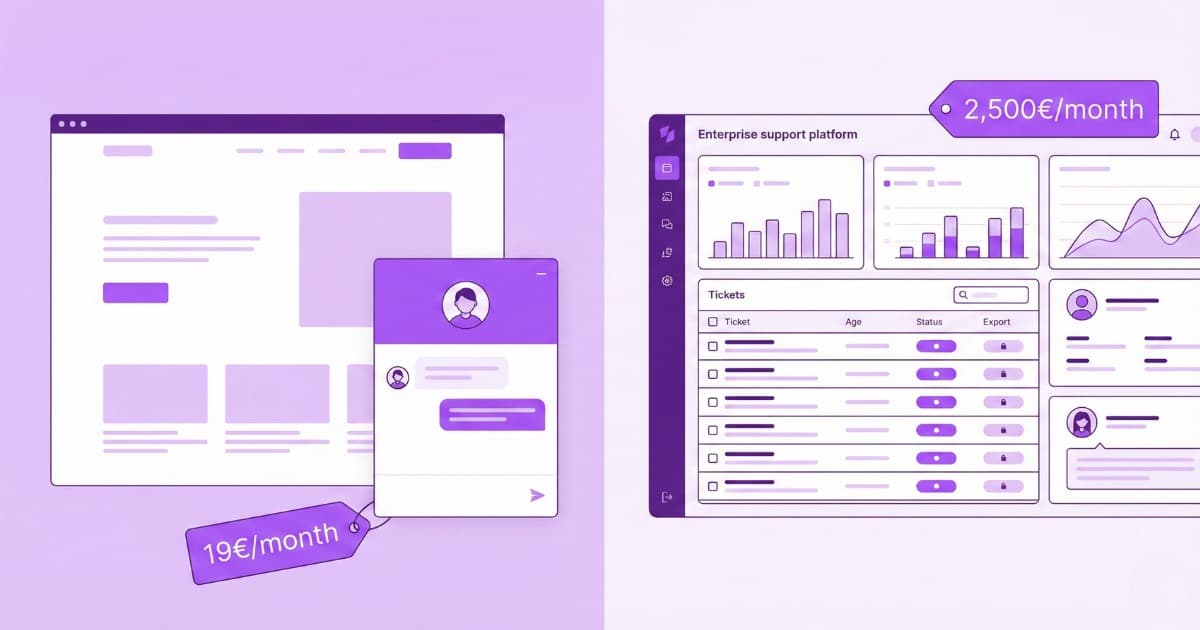
This is the question that saves most people the most money, and almost no comparison asks it. Freshdesk is a full helpdesk: a platform for running a support team: it turns emails, calls, chats and social messages into tracked tickets, routes them to the right agent, runs them against SLA deadlines, and gives you dashboards on agent performance and resolution times. If that’s what you need (a ticketing and support-operations system), then your alternatives are other helpdesks (Zendesk, Zoho Desk, Help Scout), and you should pick on features and price.
But a lot of businesses sign up for a helpdesk when what they actually want is much narrower: an AI that answers customers on their website and WhatsApp, using their own information, so the same questions stop landing in the inbox. That’s not a ticketing platform: it’s an answering layer, and it costs a fraction of the price. If you don’t have a multi-agent support desk, you probably don’t need to pay for one. Keep that split in mind as you read: some tools below are helpdesks, some are answering layers, and a couple try to be both.
What actually separates these tools
Ignore the feature checklists for a second. Five things decide what you’ll pay and whether it fits:
- Helpdesk or answering layer. Do you need tickets, SLAs and agent queues, or just AI answering your customers? This one decision rules out half the list for you.
- How the AI is billed. Per conversation/session (Freshdesk’s Freddy), per resolution (Intercom, HubSpot, Gorgias), as a per-agent add-on (Freddy Copilot), or flat and included (Bravos). This line is the difference between a bill you can forecast and one that spikes in your busiest month.
- Does the bot answer with your data? Most now ingest your help articles and answer from them: that’s RAG. The real gap is structured search over a product catalog (filter by price, size, stock) versus plain article lookup.
- Channels, especially WhatsApp. A web widget is table stakes; WhatsApp is where a huge share of customer conversations happen, and most helpdesks only reach it through an integration (and extra cost).
- Human handover. Can a person step into the chat when the bot should step aside, and does it cost extra per agent?
Freshdesk alternatives at a glance
| Tool | Type | From (monthly) | How AI is billed | |
|---|---|---|---|---|
| Freshdesk (for reference) | Helpdesk | ~$23/agent | Freddy: per session + Copilot add-on | Via integration |
| Bravos AI | Answering layer | $23/mo | Flat (included) | Native |
| Zoho Desk | Helpdesk | $20/agent | Zia, by plan tier | Via integration |
| Help Scout | Helpdesk | $30/user | AI answers add-on | Via integration |
| Zendesk | Helpdesk | ~$69/agent | Per resolution + Copilot | Via integration |
| Gorgias | Helpdesk (ecommerce) | $60/mo (300 tickets) | ~$1 per AI resolution | Yes |
| Intercom | Messaging + AI | $39/seat | $0.99 per resolution | Add-on |
| Tidio | Chat + AI | $29/mo | Add-on, per conversations | Yes |
| HubSpot | CRM + Service Hub | ~$20/seat* | $0.50 per resolution (Pro+) | Yes |
All “From” figures are the monthly rate (what you pay month to month). Most vendors knock 15-20% off for an annual commitment, which only pays off once you’re sure the tool fits. * HubSpot’s seat price isn’t published cleanly, so treat it as an estimate.
What you’d actually pay per month
Sticker prices hide the real cost, because helpdesks charge per agent and the AI is usually metered on top. So here’s a realistic scenario: a small support team of about 5 agents handling roughly 500 customer conversations a month, with AI resolving around 350 of them on its own. These are ballpark monthly totals to compare orders of magnitude, not quotes: base prices are verified, and the AI math applies each vendor’s published rate to that scenario.
| Tool | ~ Monthly total | Why |
|---|---|---|
| Bravos AI | $59 flat | Doesn’t move with agents or volume (PRO; Starter $23) |
| Zoho Desk | ~$100 | Standard $20/agent × 5 (Zia AI on the plan) |
| Tidio | ~$100–175 | Starter + a Lyro block sized for ~500 conversations |
| Help Scout | ~$150+ | Standard $30/user × 5 (AI answers billed on top) |
| HubSpot | ~$275+ | Professional (~$100) + 350 × $0.50 |
| Freshdesk | ~$330 | Pro $66/agent × 5 (Freddy Agent within the 500 free sessions) |
| Intercom | ~$540 | $39 seat × 5 + 350 × $0.99 resolution |
| Gorgias | ~$675 | Pro $360 (2,000 tickets) + ~350 × $0.90 AI |
| Zendesk | ~$870+ | Suite $69/agent × 5 + 350 resolutions (est. $1.5–2) + Copilot |
Illustrative scenario on monthly billing, not a quote. Notice the shape: the per-agent helpdesks grow with headcount, the per-resolution tools grow with volume, and a flat answering layer costs the same either way. In this whole list, Bravos is the only one that stays flat. Every other tool scales with agents, resolutions or tickets. The gap is widest exactly when you’re busiest.
The 8 best Freshdesk alternatives in 2026
1. Bravos AI
From $23/mo · flat pricing · an answering layer, not a helpdesk
This is us, so read it with that in mind, and we’ll be the first to tell you what Bravos is not: it’s not a ticketing helpdesk. There’s no SLA engine, no agent queues, no email-as-tickets, no phone channel, no agent-performance dashboards. If you need to run a multi-agent support desk, Bravos is the wrong tool: look at Zendesk or Zoho Desk below.
What Bravos does is the other half of the problem, and it does it cheaply: an AI chatbot trained on your own content (site, docs, product catalog) that answers customers on your website and WhatsApp, 24/7, in their own words. The AI is included in a flat plan ($23/mo Starter, $59/mo PRO): no per-agent seats, no per-session metering like Freddy. Two things set it apart from most helpdesk bots: it’s a verified Meta Tech Provider, so WhatsApp connects in one click with no middleware, and on top of standard RAG it runs structured search over your catalog (ask “waterproof jackets under $80 in size M” and it filters the real data instead of paraphrasing an article). And when the bot should step aside, human takeover (live chat) is built in on Pro: a person jumps into the same conversation and replies in real time, and because there are no per-agent seats, bringing in a human doesn’t cost extra like it does on a helpdesk. It’s natively trilingual plus 15+ widget languages, and there’s a 7-day PRO trial with no card.
Pick it if what you actually want is AI answering customers on your site and WhatsApp from your own data, on a flat bill, and you sell products with a catalog. Skip it if you need a real ticketing helpdesk with SLAs, queues and multichannel agent ops: that’s a different category.
2. Zoho Desk
From $20/user/mo · a full helpdesk · best for a tighter budget
If you genuinely need a helpdesk and Freshdesk feels overpriced, Zoho Desk is the most direct like-for-like at a lower price: tickets, SLAs, multichannel, automations and reporting, from $20/agent/month on the Standard plan (there’s even a free tier for up to 3 agents). Its AI, Zia, is bundled into the plan tiers rather than metered per conversation, which makes the bill more predictable than Freddy’s per-session model. The catch is the usual Zoho one: it’s at its best when you already live inside the wider Zoho suite, and the interface is dense.
Beyond the price, what you get is a genuinely full helpdesk: ticket workflows (its Blueprint automation), multichannel inboxes, a self-service portal and knowledge base, and solid reporting: the depth Freshdesk charges more for. The honest downside is that Zoho Desk shows its age next to Help Scout or Intercom, and some of the better automation is gated to higher tiers, so read the plan limits before you commit.
Pick it if you want a proper helpdesk for less than Freshdesk. Skip it if you want something lightweight and modern, or you don’t use anything else from Zoho.
3. Help Scout
From $30/user/mo · simple, email-first helpdesk · best for small teams that live in the inbox
Help Scout is the friendly, uncluttered end of the helpdesk world: a shared inbox that feels like email, light ticketing, and a clean knowledge base. Small teams set it up in a day and never fight the interface. The trade-off is scope and price creep: it starts at $30/user/month (Standard), the AI answers are billed on top, and it deliberately skips the heavy routing, SLA engines and deep reporting that Freshdesk and Zendesk carry, which is a feature for a 3-person team and a wall for a 30-person one.
What makes it different is the philosophy: customers get replies that look like normal emails, not ticket numbers, which keeps support feeling personal. Its Docs knowledge base and the Beacon widget let people self-serve or start a conversation from inside your site or app before they ever email you, and the clean, no-clutter interface is a big part of why small teams rate it so highly.
Pick it if you’re a small team that mostly answers email and wants zero complexity. Skip it if you need serious automation, SLAs or omnichannel volume.
4. Zendesk
From ~$69/agent/mo · the heavyweight helpdesk · best for large support teams
If you’re scaling a real support organisation (tickets, queues, SLAs, omnichannel routing, deep reporting), Zendesk is the heavyweight and it’s genuinely good at it. But the AI economics are the opposite of simple: Suite Team is around $69/agent/month on monthly billing, its AI agents are billed per automated resolution, and the Copilot that helps your human agents is a separate add-on again. A fully AI-enabled seat is seat + resolutions + Copilot: three line items, and the most expensive option in this list for our scenario.
What you’re paying for is the deepest platform in the category: the largest app marketplace (over a thousand integrations), the most powerful routing and SLA engine, omnichannel across email, chat, voice and social, and reporting a data team can live in. It’s the safe enterprise choice and, for a small team that just wants to answer questions, genuine overkill at enterprise prices.
Pick it if you’re a mid-to-large support org that needs the full platform. Skip it if all you want is a chatbot that answers: you’ll pay enterprise prices for a fraction of what you use.
5. Gorgias
From $60/mo (300 tickets) · ecommerce helpdesk · best for Shopify stores
Gorgias is the helpdesk built for online stores: it plugs deep into Shopify (and BigCommerce, Magento), so agents see and edit orders, refunds and subscriptions without leaving the ticket. Its pricing is ticket-based, not per-agent (from $60/month for 300 tickets up to $360 for 2,000), and its AI Agent is billed per resolved conversation (around $0.90–1 each). That can be efficient for a lean team with seasonal spikes, or expensive and hard to forecast at high volume.
Beyond answering tickets, it’s built to drive sales: Gorgias tracks the revenue its agents (and its AI) generate, surfaces upsell and cross-sell moments inside the conversation, and leans on templates tied to your store’s live data. That sales-desk angle is unique in this list, and completely irrelevant if you’re not running an online store, which is the real thing to weigh before the price.
Pick it if you run a Shopify store and want order actions inside support. Skip it if you’re not ecommerce, or your ticket volume is high and unpredictable.
6. Intercom
From $39/seat/mo + $0.99/resolution · AI-first messaging · best for product-led teams
Intercom (now leaning on its “Fin” AI brand) is more of a messaging-and-AI platform than a classic ticketing desk, and its Fin agent is strong. But the billing is the thing to watch: $39/seat/month on monthly billing plus $0.99 for every conversation Fin resolves. A busy month moves your bill a lot. We put it head-to-head with eight other tools in the best Intercom alternatives.
It’s less a ticketing desk and more a messaging platform: an in-app messenger, proactive messages, product tours and a strong AI agent (Fin). That suits product-led SaaS companies that want to talk to users inside the product, not just answer tickets. For a classic support inbox it’s powerful but pricey, and the per-resolution billing punishes exactly the high-volume months you’d most want help with.
Pick it if you want a polished AI-first messaging platform and can live with per-resolution pricing. Skip it if you want a predictable bill.
7. Tidio
From $29/mo · chat + Lyro AI · best for small ecommerce
Tidio is the easy, launch-in-an-afternoon option for small stores: live chat plus an AI (Lyro) that answers from your FAQs and a scrape of your site. It’s not a full helpdesk and doesn’t pretend to be. The catch is scaling: Lyro is a separate add-on billed by conversation blocks on top of the base plan, and the jump from the mid plan to the top one is steep: growth can multiply your bill overnight.
Where it fits is speed and small ecommerce: a visual flow builder for button-based flows, native Shopify and WordPress plugins, and one inbox for web chat, Messenger and Instagram: a store can be live in an afternoon. Lyro sits on top of that as the AI layer rather than being the core of the product, so it’s at its best on straightforward FAQ questions and leaner than a purpose-built AI on anything that needs real reasoning over your catalog or docs.
Pick it if you run a small store with modest volume and want something simple today. Skip it if you expect to scale fast.
8. HubSpot Service Hub
From ~$20/seat* · AI $0.50/resolution (Pro+) · best for existing HubSpot users
If your sales and CRM already run on HubSpot, Service Hub keeps support in the same place and lets the bot use your CRM data. But the real AI (Breeze) is only on Professional and Enterprise, billed at $0.50 per resolved conversation in HubSpot credits shared across the whole Breeze suite (which makes month-to-month cost genuinely hard to compare), and the step up to Professional is a big jump.
The whole point is the CRM: every ticket sits next to the contact’s full history (deals, emails, marketing), so support has context most helpdesks don’t, with tickets, a knowledge base and customer surveys built in. It only adds up if you’re already paying for HubSpot, though; standalone, you’re buying a whole CRM platform just to get a support tool.
Pick it if you’re already a HubSpot shop. Skip it if you’re not: you’d buy a whole CRM to get the chatbot.
The short version
- You just need AI answering customers (web + WhatsApp), flat bill: Bravos AI.
- A full helpdesk for less than Freshdesk: Zoho Desk.
- Simple, email-first support for a small team: Help Scout.
- Large team, full platform: Zendesk.
- Shopify store: Gorgias.
- Polished AI-first messaging: Intercom.
- Small store, launch today: Tidio.
- Already on HubSpot: HubSpot Service Hub.
FAQs
Is there a free alternative to Freshdesk?
Freshdesk has a free tier for small teams, and so do a few alternatives: Zoho Desk is free for up to 3 agents, and Chatwoot is free if you self-host. If you only need AI answering customers (not a full ticketing desk), Bravos runs a 7-day PRO trial with no card and starts at $23/month with the AI included, often cheaper in practice than a “free” helpdesk once you add its paid AI.
Why did Freshdesk get more expensive in 2026?
Freshdesk raised its base plans in 2026 (its first increase in years) and the AI is billed separately on top: Freddy Copilot is +$29 per agent and only on Pro or higher, and Freddy AI Agent is metered by conversation (500 included, then about $0.49 each). For a small team that wants the AI, the effective price climbs fast.
What’s the cheapest Freshdesk alternative with AI included?
For a real helpdesk, Zoho Desk (from $20/agent) bundles its Zia AI into the plan. For an answering layer rather than a helpdesk, Bravos includes the AI in a flat $23–$59/month with no per-resolution or per-session fees. The right “cheapest” depends on whether you need tickets and SLAs or just AI answers.
Do I need a helpdesk, or just a chatbot?
If you run a support team that tracks tickets, routes them between agents and reports on SLAs, you need a helpdesk (Freshdesk, Zendesk, Zoho Desk). If you’re a smaller business and most of your questions are repetitive ones a bot could answer from your website, docs and catalog, an answering layer like Bravos does that job for a fraction of the price, and you can always add a helpdesk later if you grow into one.
Maybe you don’t need a whole helpdesk
If what you want is AI answering customers on your website and WhatsApp from your own data (on a flat bill, no per-agent seats, no per-resolution fees), that’s Bravos AI. Try PRO free for 7 days, no card required.
Try PRO free for 7 days